
PennyLane
Propelling aerospace applications with Xanadu’s PennyLane, Rolls-Royce, and AMD
By Josh Izaac · March 10, 2026


Xanadu, Rolls-Royce, and AMD have partnered to scale the critical quantum algorithms needed for next-generation jet engine design — performing large scale compilation and execution of computational fluid workflows on AMD GPUs with PennyLane. Read on to learn more about bridging the gap between quantum computing and aerospace engineering.
By Josh Izaac
Designing the next generation of efficient, low-emission jet engines is a monumental task that relies heavily on computational fluid dynamics (CFD) to model airflow through turbine blades. To push the boundaries of this research, developers need tools capable of compiling and simulating complex quantum algorithms at an industrial scale, and hardware to support large-scale simulations.
Working together with Rolls-Royce and AMD, we have successfully scaled up the compilation and simulation of the Quantum Singular Value Transformation (QSVT) algorithm — a leading candidate algorithm for solving massive systems of linear equations on future Fault-Tolerant Quantum Computers (FTQC).
By combining Xanadu’s PennyLane, the Catalyst just-in-time compiler, and AMD Instinct™ MI300X GPUs, we executed a 256 x 256 CFD matrix on 20 qubits with 35 million gates in under two hours — a problem size that has never been executed in a quantum setting. Separately, we have demonstrated simulation speedups of 25x on AMD GPUs, and that PennyLane is capable of dynamic compilation of QSVT workflows with over 60 qubits and millions of hardware-native gates.
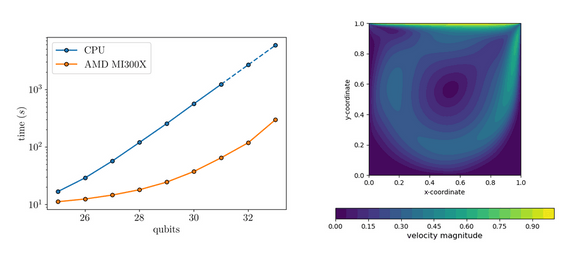
Read our latest PennyLane blog post to dive deep into the science behind bridging quantum computing and jet engine design. Then, visit the AMD Developer Cloud to see how you can fast-track your own quantum simulations with PennyLane and AMD.
Additional resources
- Press Release: Xanadu and AMD Partnership Accelerates Quantum Computing for Aerospace and Engineering
- AMD Blog: Propelling aerospace innovation: scaling quantum workflows on AMD GPUs with Rolls-Royce and Xanadu
- PennyLane Blog: Propelling aerospace simulations with Rolls-Royce, AMD, and PennyLane
- AMD Developer Cloud: Get started with Lightning-AMDGPU
- Explore the QSVT algorithm in more detail: The PennyLane Guide to Hamiltonian Simulation
Published on March 10, 2026
Blog
Related articles
![]() Blog
Unlocking real-time speed for the quantum ecosystem with Backline from Xanadu and AMD
September 10, 2026
Xanadu and AMD have partnered to introduce Backline, an open platform for compilation and low-latency execution that dynamically connects quantum…
![]() Blog
Accelerating quantum workflows with Xanadu's PennyLane and AMD
December 16, 2025
Xanadu and AMD have partnered to unleash the full potential of PennyLane on AMD hardware. Scale your quantum research effortlessly — from the AMD…
![]() Blog
QHack 2022— The one-of-a-kind celebration of quantum computing
March 28, 2022
Every year, QHack brings together people from all over the world to celebrate quantum computing. QHack 2022 was bigger, better, and groovier than…


