
Photonics
The photonic qubit of the future
June 4, 2025


Xanadu's latest hardware breakthrough.
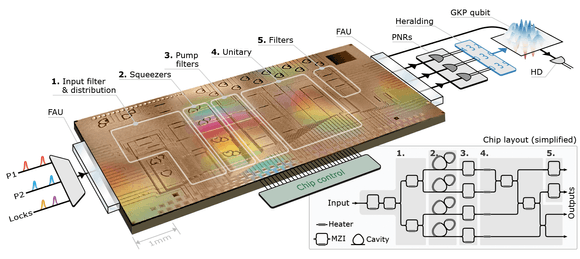
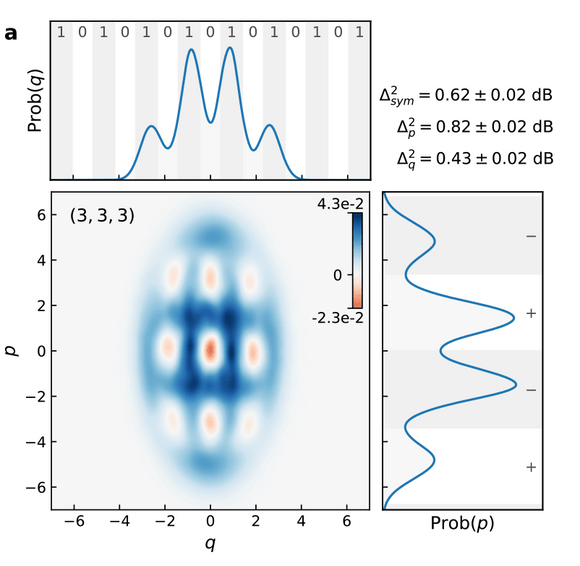
Today, we announced the first ever demonstration of GKP qubits on an integrated photonic chip. This is a significant breakthrough in creating qubits that are robust and error resistant, and was published in Nature. This achievement builds upon our other recent hardware milestone, Aurora, where we built a quantum computer that was modular, scalable, and networked.
During the publication process for our paper “Integrated photonic source of Gottesman-Kitaev-Preskill qubits”, the editors of Nature invited us to contribute a Research Briefing.
Have a read of that summary to share with us the excitement behind this critical milestone on Xanadu’s mission to build quantum computers that are useful and available to people everywhere.
Published on June 4, 2025
Blog
Related articles
![]() Blog
Lighting up the quantum computing horizon with Aurora
January 22, 2025
A peek inside Xanadu’s latest and greatest photonic quantum computer—Aurora.
![]() Blog
Constructing logical gates for low-density parity-check (LDPC) codes
October 15, 2024
We discuss Xanadu's state-of-the-art method for constructing logical gates fault-tolerantly to achieve universal quantum computation using general…
![]() Blog
Beating classical computers with Borealis
June 1, 2022
The story behind the story of the world’s first public cloud-deployed computer with quantum computational advantage By Jonathan Lavoie and Zachary…


