
Applications
Quantum computing for photodynamic cancer therapy
By Stepan Fomichev and Yanbing Zhou · January 29, 2026


We've developed a quantum screening approach for photodynamic cancer drug discovery that overcomes key classical limits and fits comfortably under realistic fault-tolerant hardware assumptions. Read on to see how our latest research bridges the gap between algorithmic efficiency and real-world medical breakthroughs.
By Stepan Fomichev and Yanbing Zhou
Drug discovery is perhaps one of the most frequently cited future applications of quantum computers. And yet it is far from obvious how this would happen, even if you had a utility-scale, fault-tolerant quantum computer in hand. You would still need to answer the question: what do I actually do with the quantum computer, when it is here, to discover new therapies and medicines?
In our recent manuscript [1], we aim to provide a concrete answer to that question. We focus on a very specific and clinically relevant drug discovery problem of identifying new light-sensitive molecules — photosensitizers — relevant to photodynamic cancer therapy. Rather than reduce the problem to ground-state energy estimation, as most quantum chemistry studies do, we approach the challenge from first-principles and pinpoint the key therapeutic variables that make a good photosensitizer [2,3].
With the key computational targets selected, we devise sophisticated fault-tolerant quantum algorithms to tackle the photosensitizer simulation — and manage to do so with remarkably few qubits and gates.
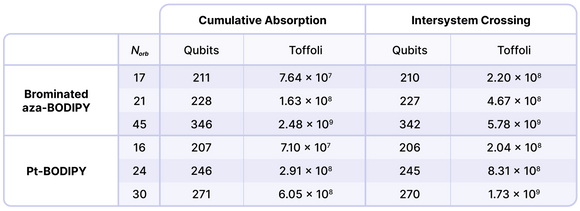
As can be seen from the table, not only is the absolute cost of the algorithms low, but it also grows slowly with system size. By contrast, when using classical computing methods that are complex enough to provide the accuracy needed by this application, the memory and runtime requirements rise prohibitively fast, placing many of the interesting systems out of reach. Instead, the efficient quantum algorithms studied here illustrate how early-stage quantum screening of photosensitizer candidates could be carried out before any effort is spent in synthesizing them in the laboratory.
The rest of this post will describe this application and the associated algorithms in more detail. Even while we continue to improve the methodology, we are already actively pursuing partnerships with photodynamic therapy developers to evaluate how it would fit into existing pharmaceutical R&D processes.
How can a quantum computer help develop cancer treatments
One promising direction in cancer therapy is photodynamic therapy, which uses light as an external "on-switch" for treatment. A drug is administered in an inactive form, and only becomes effective when light is applied to the tumor region, giving doctors spatial control over when and where the treatment acts. Compared to traditional therapies that act throughout the body, this approach may reduce collateral damage to healthy tissue and limit side effects. For this reason, light-activated cancer treatments have drawn increasing attention in recent years.
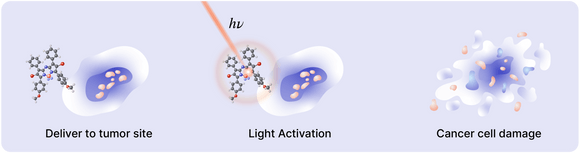
The success of this approach ultimately depends on what happens at the atomic scale. The drug itself is built around light-activated molecules, and their behavior after absorbing light determines whether the treatment works.
First, the light-activated molecules must be sensitive enough to absorb light efficiently in the right wavelength range, so the treatment can be triggered deep inside target tissue.
Second, once excited, they must use that absorbed energy efficiently to produce cancer-damaging effects, instead of dissipating it harmlessly.
Both steps are governed by excited-state quantum behavior, which becomes hard to predict with classical simulation tools as molecular complexity grows. Quantum computers are naturally suited to modeling this kind of quantum dynamics, making photodynamic cancer therapy a compelling case study for application-driven quantum computing.
Absorb more light in the 'right' window
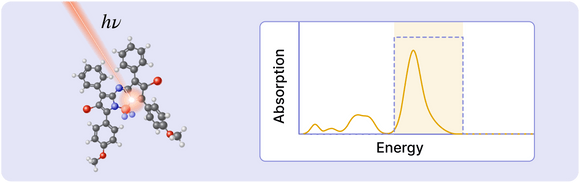
For photodynamic therapy, "better absorption" does not mean reproducing a detailed absorption spectrum. What matters is much more practical: how likely the molecule is to absorb light in the narrow wavelength range that can actually reach a tumor — roughly 700 to 850 nanometers [4,5]. This window is tightly set by the absorption properties of human tissue: any light above 900 nanometers will be captured by the water in our bodies, while below around 650 nanometers the hemoglobin in our blood is the main obstacle. In our work, we capture this with a single quantity we call cumulative absorption, which measures the total optical "weight" the molecule has inside that window, without caring about how that weight is distributed across individual spectral lines.
The quantum trick is to turn that into a one-bit question we can ask repeatedly: if we excite the molecule with incoming light, what fraction of that excited-state population lies inside the target energy window? Instead of tracking individual excited states, the quantum algorithm prepares a state that represents all optically accessible excitations at once, weighted by how strongly each one couples to light. We then apply an energy-window filter that checks whether a given excitation falls inside the therapeutic range. This filter is implemented using the efficient quantum algorithmic primitives of qubitization and quantum signal processing, which lets us sharply and cheaply separate "inside the window" from "outside the window" without reconstructing the full spectrum.
After filtering, a single qubit measurement heralds an "in-window" versus "out-of-window" outcome. Repeating this gives a clean estimate of how much optically accessible excitation sits inside the therapeutic range. We then use a double-measurement trick that extracts two independent samples from the same circuit run — one from the filter decision itself, and one from checking how much of the projected state overlaps with the original excitation. Intuitively, we ask the same yes/no question twice in two different ways, cutting the sampling cost roughly in half.
Generate more 'killer' oxygen
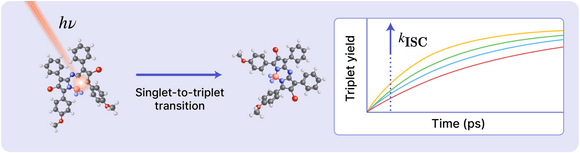
Once light is absorbed, the next bottleneck is whether that energy actually gets converted into something that damages cancer cells. For photodynamic therapy, this hinges on intersystem crossing: a spin-forbidden transition that moves excited state population from the singlet to the triplet spin configuration. The triplet states then go on to generate reactive oxygen, which is highly damaging to cancer cells. In practice, higher intersystem crossing efficiency means more triplet population, and therefore more cancer-damaging oxygen for the same amount of absorbed light.
Here again, the key idea is not to compute an exact rate with all microscopic details, but to ask a simpler, decision-relevant question. Directly simulating intersystem crossing rates means tracking many closely spaced excited states, vibrational effects, and long-time dynamics, which quickly becomes costly and system-specific. Instead, we focus on short-time singlet-triplet mixing driven by spin-orbit coupling, which captures the dominant factor that determines whether intersystem crossing will be strong or weak. Intuitively, we let singlet and triplet states briefly "talk to each other" and measure how quickly amplitude flows between them. Fast mixing signals efficient intersystem crossing; slow mixing does not. This short-time proxy is sufficient to give a reliable relative ranking, without computing full rates or simulating detailed nonradiative dynamics.
Algorithmically, this becomes a compact circuit: prepare the relevant excited states, evolve them for a short time under the spin—orbit Hamiltonian, and read out the singlet-triplet transition amplitude using a modified Hadamard test. Because the spin-orbit Hamiltonian is a simple one-body operator, this evolution can be implemented efficiently, without the heavy machinery needed for full excited-state dynamics. The result is a scalable way to rank photosensitizer candidates by how effectively they funnel excitation into triplet states, which is exactly the property that controls how much reactive oxygen they can ultimately produce.
Together, cumulative absorption and intersystem crossing capture the two bottlenecks that determine whether a photosensitizer candidate actually works in practice [2,3]. By targeting these two properties directly, the quantum algorithms form a coherent screening process, rather than isolated calculations. All resource estimates in this work were generated using PennyLane’s fault-tolerant resource estimation tools, which are openly available and designed to support application-driven quantum algorithm design. Our resource estimates suggest that photosensitizers with active spaces on the order of a few dozen orbitals could be studied using a few hundred logical qubits and around 107-109 Toffoli gates. These are some of the lowest resource requirements when it comes to quantum applications currently developed in the field, and in fact are low enough to place this approach within reach of realistic fault-tolerant quantum devices.
What's next
The quantum algorithms presented here — for calculating therapeutic window absorption and for relative intersystem crossing rates — can form the foundation of a multi-level "funnel" of screening for high-quality photosensitizer candidates. Their low qubit and gate cost, as well as the ability to provide high accuracy more cheaply than equivalent classical methods, position them as an attractive application of quantum computing in a real-world industrial setting.
This work motivates several directions for extending and refining this methodology — such as further algorithmic optimizations, a more complete accounting of the biological environment, and simulating direct radical formation that avoids the intersystem crossing pathway. We welcome readers interested in the technical details to browse our accompanying paper [1], and invite research teams exploring photodynamic therapy or related drug discovery workflows for further discussion.
References
[1] Zhou, Y. et al. Quantum algorithms for photoreactivity in cancer-targeted photosensitizers. arXiv 2512.15889 (2025).
[2] Drzewiecka-Matuszek, A. et al. Application of TD-DFT theory to studying porphyrinoid-based photosensitizers for photodynamic therapy: A review. Molecules 26, 7176 (2021).
[3] MacDonald, I. J. & Dougherty, T. J. Basic principles of photodynamic therapy. J. Porphyrins Phthalocyanines 5, 105–129 (2001).
[4] Aung, W. et al. Comparative evaluation of wavelength-dependent photodynamic therapy efficacy using representative red and near-infrared photosensitizers in a single tumor model. Technol. Cancer Res. Treat. 24 (2025).
[5] Weissleder, R. A clearer vision for in vivo imaging. Nat. Biotechnol. 19, 316–317 (2001).
Published on January 29, 2026
